

Bill Shoemaker would have turned 90 on Aug. 19. He made it to 72, upon his death in the fall of 2003, which probably was for the best. He already had lived a dozen years as a quadriplegic dependent upon round-the-clock care. Another 18 would have been intolerable to Shoe, whose encroaching depression was cloaked in what remained of a brave front deployed to keep close friends and family from weeping with daily sorrow.
That brave front allowed more casual friends and Shoemaker's wider Thoroughbred racing family to savor without serious discomfort their occasional encounters with the legend, now strapped securely in his sip-and-puff powered wheelchair and bundled against the inevitable chill, no matter what the ambient temperature. To the end, Shoe still could crack wise, or talk horses, or summon a twinkle in those sharp eyes he took off the road for the terrible split second in which he lost control of his Ford Bronco, rendering the last act of his remarkable life to might-have-been.
What Shoemaker could have been, had he not lost the use of his arms and legs, is one of the most successful trainers in the West, or at least as successful as he wanted to be. He retired from riding in 1990 at 58 and was hurt only a year later, which was enough time to confirm that good owners were sending smart horses his way. Oddly enough, his best year was 1991, the year he was hurt, when the spade work of Shoemaker's first training season began to pay off, thanks to the diligence of assistant Paddy Gallagher, who manned the ship while the boss healed enough to return. In a chair.
Shoemaker would have been on his horses daily, sorting through their abilities, imparting his gentle touch, and thrilling to the discovery of gems. Gallagher will never forget the morning Shoe slid off a 3-year-old filly from England, late in 1990, bought for a relative song by a partnership that included local track bosses R.D. Hubbard and Ed Allred. Named Fire the Groom, she'd done nothing more than win a couple of minor handicaps.
"Shoe was wearing this grin and says, 'She'll win some big ones,'" Gallagher recalls.
And she did, as long as the 1991 running of the Beverly D. Stakes (G1T) at Arlington International Racecourse is considered a big one. Later on there was Glen Kate, winner of the Hong Kong International Bowl (G1), and Diazo, winner of the Strub Stakes (G1) and the Pegasus Handicap (G1). But the clock was always ticking, and the strain of merely surviving each day without pressure sores or filled lungs or dark thoughts of rolling his chair into the pool began to wear on Shoemaker's endurance. He closed his stable in November of 1997.
So 90 was not an option for Shoe, which means Aug. 19, 2021, is allowed to stand as the 90th anniversary of the birth of America's greatest jockey—the one with 15 national titles and 11 Triple Crown classics and elected into the Thoroughbred racing Hall of Fame at age 27.
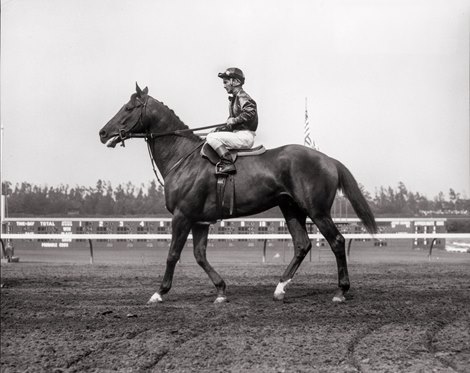
Shoemaker was famous when Thoroughbred racing was wildly popular, and contemporaries like Eddie Arcaro, Johnny Longden, and Bill Hartack were household names. Then he was still famous when other sports had overtaken racing, because the name Shoemaker stuck like glue to the psyche. That was the little man himself posed alongside Wilt Chamberlain for Annie Leibovitz, chatting with Johnny Carson on "The Tonight Show," in-country with Charlton Heston on a USO tour to Vietnam. Decades before Victor Espinoza followed American Pharoah's coattails onto "Dancing With the Stars," that was Shoemaker singing and hoofing for Burt Bacharach and Angie Dickinson on the network variety show "Hollywood Palace."
(And here's Shoe and Kareem Abdul-Jabbar in a PSA for, of all things, space technology, complete with lame height jokes)
It was a good thing Shoemaker had Del Mar to celebrate his birthdays. The track meant a lot to his history, and between golf, tennis, and cocktails, he was always ready for the good times permeating the summer racing season.
Shoemaker won his first meet title anywhere at Del Mar in 1949 as an apprentice. Four years later he set a record that still stands with 94 winners in 41 days. He won his seventh Del Mar title in 1970 and made history on Sept. 7 that summer, much to the joy of a record Labor Day crowd that witnessed Shoemaker score in the fourth race under Dares J, a 2-year-old daughter of Stevward, to break the record of 6,032 winners held by Johnny Longden. In recognizing the achievement, the Pulitzer Prize-winning New York Times columnist Red Smith fired a hyperbolic shot that resonates to this day.
"If Bill Shoemaker were six feet tall and weighed 200 pounds he could beat anybody in any sport," Smith wrote. "Standing less than five feet and weighing around 100, he beats everybody at what he does. Pound for pound, he's got to be the greatest living athlete."
Among the living athletes doing some of their best work in 1970 were Jack Nicklaus, Bob Gibson, Arthur Ashe, Pele, Joe Frazier, Muhammad Ali, Mark Spitz, Bobby Orr, Bob Seagren, and Jim Plunkett.
Shoemaker rode his last race at Del Mar on Sept. 10, 1989, closing the books with 889 local winners, a number since surpassed by only Laffit Pincay. As a result, Shoemaker missed out on any opportunity to ride what has become Del Mar's signature race, the $1 million Pacific Classic (G1), which will have its 31st running this Saturday, Aug. 21.
But Shoe did scoop up just about everything else worth winning at Del Mar, including six versions of the Del Mar Futurity, five runnings of the Del Mar Debutante, and five Ramona Handicaps before it became the John C. Mabee Stakes (G2T). He took eight renewals of the Del Mar Handicap between 1950 and 1987, those eight spread over a variety of permutations from nine furlongs on dirt (Frankly, Goose Khal, Stranglehold), 11 furlongs on turf (Pinjara and Swink), and just shy of 10 furlongs on dirt (Riot in Paris, Muttering, Bel Bolide).
The Del Mar Handicap Presented by the Japan Racing Association (G2T) will be run for the 82nd time on the Pacific Classic undercard, along with the Del Mar Oaks (G1T), the Del Mar Mile (G2T), and the Torrey Pines Stakes (G3). It should be a great afternoon of sport, weather always permitting, and no one will complain if at the end of the day someone strikes up a chorus of "Happy birthday to Bill…"