

Even a cursory look at the fields set for the Breeders' Cup World Championship races Oct. 30-31 at Keeneland validates the "World" part of the name and a key reason is the international Breeders' Cup Challenge Series: Win and You're In.
The series is year-round and worldwide, and offers incentives to owners and trainers to bring horses to big races. The allied hope, of course, is that interest builds in those countries with viewership and wagering following along.
Winners of the designated races are granted guaranteed starting positions in the corresponding Breeders' Cup race, waiver of pre-entry and entry fees, and a travel allowance to cover all or part of the substantial cost of shipping a horse from such distant jurisdictions as Korea, South Africa, Argentina, Japan, and Peru—all of which were blessed with "Win and You're In" races.
The proof is in the pudding or, in this case, on the Keeneland turf and dirt. All save one of the seven Breeders' Cup turf races has at least one "graduate" of the series. And the field for the outlier, the Breeders' Cup Juvenile Turf Sprint (G1T), which had only two international qualifying races, includes Moonrise, who scored a "Win and You're In" spot in the Breeders' Cup Juvenile Fillies Turf (G1T).
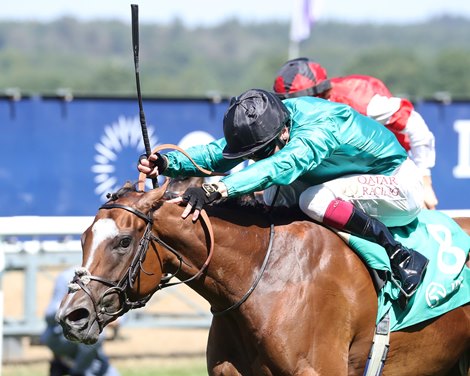
Overall, 36 horses qualified for a Breeders' Cup turf race through the international Challenge Series races; 17 have seized the opportunity, with five running in races other than those for which they qualified.
Most of the acceptances arrive from Europe, but Eccentric, who qualified for the Breeders' Cup Turf (G1T) in her native land, is in the field for the Breeders' Cup Filly and Mare Turf (G1T) with Wesley Ward taking over training duties for Don Alberto Stable.
The international part of Breeders' Cup is intimately intertwined with the International Racing Bureau, based in Newmarket, England. The IRB has recruited runners throughout the history of the program and is also the driver of global competition for most of the world's international festivals.
Adrian Beaumont, IRB director of racecourse services, has been there from the first and says the recruiting value of the "Win and You're In" program now hinges on the travel awards of up to $40,000.
"The Breeders' Cup Win and You're In Challenge program does make a difference—particularly for horses owned by syndicates or those not owned by the super rich," Beaumont told BloodHorse.
"When it was just a guaranteed start it was cosmetic. But now with the (travel) fees being paid, it is a huge incentive to run.
"A lot of trainers do now aim at them to try and get their golden ticket—not only for the fees but for a guaranteed spot in the race. You will have seen that Adonius shipped here and won a grade 3 race at Keeneland that was previously in the Challenge program, but he's missed out because it was dropped this year."
The reference was to the Irish-bred gelding who traveled to the United States early to contest the Indian Summer Stakes (G3T) at Keeneland. The talented son of Soldier's Call won the race, but wasn't selected into the Breeders' Cup field (he is the third also-eligible for the Breeders' Cup Juvenile Turf Sprint (G1T), which is capped at 12 starters).
Beaumont's thought about the super rich pops right up in the field for the Breeders' Cup Classic (G1). Two of the four "Win and You're In" qualifiers are in the race—defending winner Forever Young, who qualified by winning the Saudi Cup (G1), and chief rival Magnitude , whose entry was a victory in the Dubai World Cup (G1). Neither would have needed a GoFundMe to get into the race even without subsidies.
Beaumont said the series also offers support for the IRB's efforts, and for Breeders' Cup's worldwide visibility, beyond just the equation of qualifiers to runners.
"It also helps concentrate the mind," he said. "If a horse wins a Challenge race, the media immediately start to ask if he's going to the Breeders' Cup and all that enthusiasm does help the promotion of the event."
From Keeneland to Japan
The Breeders' Cup serves as a kind of "grand finale" for the year's international racing program. But it's certainly not the end of global competition.
Hard on the heels of Keeneland's races is the Nov. 29 Japan Cup (G1) in Tokyo—a showcase for that country's best 3-year-olds and up and a tough nut to crack for foreigners. A year ago, Calandagan became the first foreign-based winner in 20 years on his way to Cartier Horse of the Year honors. Any thought of him trying the Breeders' Cup Turf evaporated as Princess Zahra Aga Khan's team is eagerly in pursuit of a repeat.
The Japan Cup is followed in turn Dec. 13 by the Hong Kong International Races—four group 1 events at distances from 1,200 meters (about 6 furlongs) to 2,400 meters (about 1 1/2 miles). As in Japan, the advantage is to the home team, especially in recent years as Ka Ying Rising and Romantic Warrior have dominated.
To the Middle East
As the calendar turns, action returns to the Middle East where several jurisdictions jockey for position around the Saudi Cup and the Dubai World Cup Carnival. There is some concern about those races because of the war with Iran. Several potential Japanese competitors stayed away this year and everyone is watching developments for 2027.
Beaumont said early indications are solid.
"We have full fields for the two international races in Bahrain on Nov. 13. Twelve horses will ship for the Bahrain International Trophy and 10 horses will ship for their new 14-furlong staying handicap. We have reserves queuing up for both races. No lack of appetite to run there," he said, adding international meetings in the first two weeks of February in Abu Dhabi and Qatar are also expecting good nominations.
"Horses are already shipping to Dubai for their Carnival over the winter. Don't think they will have any issues. ... Obviously, we'll have to see what the political situation will be after Christmas before shipping decisions are made.
"I suspect if planes are flying, then horses will be on them."
Top Jockeys to Hong Kong
The Hong Kong Jockey Club has seized opportunity from the ebb and flow of the international schedule, luring four star riders to spend some time at Sha Tin and Happy Valley racecourses during the winter lull in European flat racing.
Saffie Osborne, the first female jockey to win a British classic, is scheduled to arrive in November, to be followed by Maxime Guyon and Rossa Ryan in December and Dylan Browne McMonagle in January. All have been granted visiting jockey licenses and the three early arrivals will be available to take mounts in the International Races.
It will be the first time in Hong Kong for Ryan and Osborne, and the latter summed up expectations.
"I've been very lucky to ride in lots of different countries, and I think each place you go, you learn new things, and it makes you a better jockey," she said. "But, obviously, I would love to bang in a few winners.
"I'm just really excited to experience the atmosphere. I've never been to Hong Kong, but the atmosphere at the races looks incredible."
Yes. It is.